
Understanding Oracle NetSuite pricing shouldn’t be complicated. Azkatech breaks down the real NetSuite cost — including licensing, modules, and implementation — so businesses can make informed ERP decisions and plan with confidence.

Oracle NetSuite pricing doesn’t follow a simple fixed model. Unlike standard SaaS tools where you select a plan and pay a flat fee, NetSuite is a highly configurable cloud ERP designed to adapt to different business needs — from core accounting to inventory, manufacturing, and multi-subsidiary operations.
Because of this flexibility, Oracle NetSuite cost depends less on company size alone and more on how the system is used — including the number of users, required modules, integrations, and overall operational complexity.
Two businesses with similar headcounts can have very different pricing. A services company using only financials will have a lighter setup, while a retail or eCommerce business with inventory, warehouses, and integrations will require a broader configuration.
Another important factor is that Oracle NetSuite does not publish a fixed price list. Every quote is tailored based on scope, licensing, and implementation requirements — which is why understanding the full pricing structure is essential before making a decision.
Annual NetSuite license based on edition and scope
Access levels such as full users, employee self-service, and portals
Features like WMS, manufacturing, OneWorld, and SuiteCommerce
Discovery, configuration, data migration, and training
SuiteScript, SuiteFlow, and third-party system connections
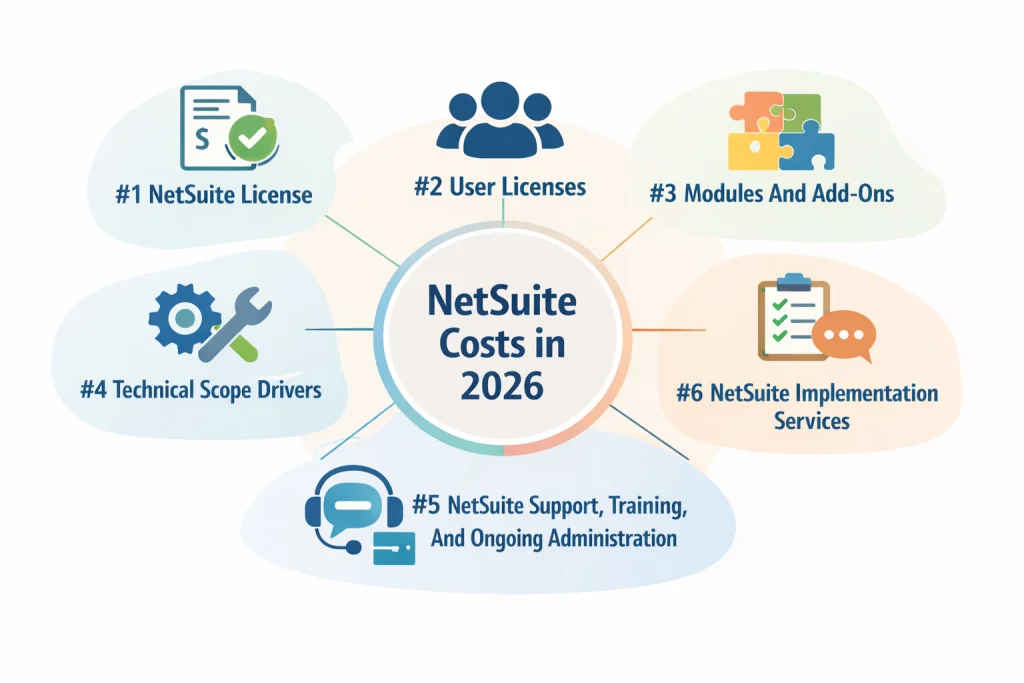
Oracle NetSuite pricing is not based on a fixed price list. Instead, each deployment is built from a combination of core components — including licensing, users, modules, and implementation.
The table below reflects typical cost ranges seen across real NetSuite projects. These are not official list prices, but practical benchmarks to help you understand how your total Oracle NetSuite cost is structured.
| Component | Typical Range (USD) | Billing |
|---|---|---|
| Core platform license | $999 – $5,000 / mo | Annual subscription |
| Full user license | $129 – $199 / user / mo | Per named user |
| Employee self-service | $15 – $25 / user / mo | Per named user |
| Planning & budgeting | ~$120 / user / mo | Per named user |
| Advanced Financials | ~$500 – $1,000 / mo | Module add-on |
| Advanced Inventory | ~$500 / mo | Module add-on |
| Manufacturing | ~$600 – $2,000 / mo | Module add-on |
| Warehouse Management (WMS) | ~$1,000 – $2,000 / mo | Module add-on |
| SuiteCommerce | Starts around ~$2,500 / mo | Module add-on |
| NetSuite OneWorld | Negotiated | Multi-entity / global |
| Sandbox environment | ~10% of license | Annual |
| CRM | Often included | Bundled |
| Implementation (one-time) | Typically 1×–2× annual license | Project-based |
Our team helps you define the right licenses, modules, and implementation scope so your budget reflects what your business actually needs.
Oracle NetSuite pricing starts with selecting the right edition. While all editions share the same core platform, the total NetSuite cost varies based on scale, users, and operational complexity.
As your business grows, you can move between editions without reimplementing the system — your data, configurations, and integrations carry over. This flexibility is a key factor in understanding your long-term Oracle NetSuite cost.
Up to ~50 employees, typically up to 10 users, single legal entity
$999 – $2,000 / mo
Growing businesses with 10+ users, multiple departments or entities
$2,000 – $5,000 / mo
Large organizations with complex operations and global requirements
Negotiated
All NetSuite editions include the core ERP platform, covering financial management (GL, AP, AR), bank reconciliation, order management, purchasing, and basic inventory.
CRM capabilities are also included, such as sales force automation, marketing tools, and customer management — before adding any optional modules.
SuiteSuccess is Oracle NetSuite’s pre-configured implementation approach designed to accelerate deployment with industry-specific dashboards, KPIs, and workflows.
It can significantly reduce NetSuite implementation cost when business requirements are standard and customization is limited. For more complex needs, a tailored implementation approach may be required.

NetSuite uses a role-based licensing model, meaning each user is assigned access based on their responsibilities. One of the biggest drivers of total NetSuite cost is how user licenses are structured.
Instead of licensing everyone as a full user, the goal is to match each role with the right level of access — this is where most businesses either control or overspend on their Oracle NetSuite cost.
Core operators — accounting, finance, sales ops, controllers, inventory managers. They run transactions and reports daily.
Submit timesheets and expenses, approve requests or view personal data. Ideal for team’s staff and managers who only touch the system occasionally.
External access for customers and suppliers — order status, invoices, PO management. Reduces AR/AP back-and-forth dramatically.
Specialised user license for Oracle NetSuite Planning & Budgeting (NSPB) workflows.
NetSuite modules are one of the biggest factors behind Oracle NetSuite pricing. While the core platform covers essential ERP functions, most businesses add modules based on their operations — and this is where NetSuite cost can increase significantly.
The key is not to activate everything at once, but to choose only the modules your business actually needs and expand over time.
| Module | What It Does | When You Actually Need It |
|---|---|---|
| Advanced Financials | Multi-book accounting, revenue recognition, budgeting | When you have complex financial reporting or multi-entity accounting |
| Advanced Inventory | Inventory planning and multi-location control | When managing stock across multiple warehouses or locations |
| Manufacturing | Work orders, production planning, routing | When you produce goods and need shop-floor visibility |
| WMS | Warehouse scanning, picking, fulfillment workflows | When warehouse operations become complex or high-volume |
| SuiteCommerce | Integrated B2B/B2C eCommerce platform | When selling online and syncing operations with ERP |
| OneWorld | Multi-subsidiary and multi-currency management | When operating across multiple companies or countries |
| SuitePeople HR | HR management, onboarding, payroll support | When managing internal HR processes within NetSuite |
| Planning & Budgeting | Forecasting, financial planning, scenario modeling | When finance teams need advanced budgeting tools |
NetSuite implementation cost is usually the largest upfront part of an ERP project. While licensing is easier to estimate, implementation depends on your processes, data quality, integrations, user roles, and customization needs.
For many businesses, implementation ranges from 1× to 2× the annual NetSuite license cost. More complex projects with heavy data migration, integrations, or custom workflows may cost more.
Your final NetSuite implementation cost depends on the scope of work: discovery, configuration, data migration, integrations, testing, training, and go-live support. The more systems, users, and custom workflows involved, the higher the project effort.
Azkatech helps businesses define scope clearly before implementation, so the budget reflects what the project actually needs — not assumptions.
Beyond licensing and implementation, integrations and customization can significantly impact your total NetSuite cost.
The key is to start with standard functionality and only expand when necessary.
Support tiers add an additional layer to your long-term NetSuite cost, especially as your system becomes more business-critical.
Oracle NetSuite pricing is not only influenced by licenses and modules — your contract structure also plays a major role in long-term NetSuite cost.
| Support Tier | Typical Cost | What You Get | Best For |
|---|---|---|---|
| Basic SuiteSupport | Included | Case submission, knowledge base, limited support access | Companies with internal admin teams |
| Premium Support | ~15–25% of license | 24/7 access, faster SLAs, dedicated contacts | Mission-critical operations |
| Advanced Customer Support (ACS) | ~20–30% of license | Proactive advisory, optimization guidance | Growing or complex organizations |
| Partner Support (Azkatech) | Custom | Hands-on support, faster response, tailored guidance | Companies seeking flexibility & cost control |
Choosing the right support tier helps control long-term Oracle NetSuite cost while keeping your system reliable as your business grows.
Not sure which support level fits your needs? Talk to an expert
Our team helps you define the right licenses, modules, and implementation scope so your budget reflects what your business actually needs.
Understanding Oracle NetSuite pricing goes beyond subscription fees and implementation. The real investment is your total cost of ownership (TCO) — the full cost of running NetSuite over time, typically across 3 to 7 years.
At the start, most businesses focus on visible costs: licensing, implementation, modules, integrations, and training. These define your initial NetSuite cost, but they are only part of the picture.
Over time, recurring costs become just as important. Your Oracle NetSuite cost evolves as you add users, expand functionality, or scale operations. Annual renewals, support services, and system maintenance all contribute to long-term spend.
There are also indirect costs that are often underestimated. Internal resources are needed for administration, optimization, and user support. As your business grows, additional configuration or customization may be required to keep the system aligned with operations.
Early decisions have a major impact on long-term cost. A clean implementation with well-structured data and processes reduces ongoing effort. Poor design choices, on the other hand, lead to workarounds, inefficiencies, and higher support or consulting costs over time.
At the same time, TCO should be evaluated alongside value. Businesses that consolidate systems, reduce manual work, and gain real-time visibility often offset their NetSuite implementation cost through operational efficiency and scalability.
The goal is not just to minimize cost — but to build a system that grows with your business without creating financial friction later.
Comparing Oracle NetSuite pricing to other ERP platforms requires more than looking at subscription costs. The real difference comes from implementation effort, scalability, and long-term total cost of ownership (TCO).
Many alternatives appear cheaper at first. However, as businesses grow, additional modules, integrations, infrastructure, and maintenance often increase overall cost.
SAP Business One
Lower upfront licensing in some cases, but higher long-term cost due to infrastructure, upgrades, and longer implementation timelines. Less predictable than a cloud-native ERP model.
Microsoft Dynamics 365
Flexible and modular, especially for companies using Microsoft tools. However, costs can increase significantly as additional modules and customizations are required.
Sage Intacct
Strong financial management at a lower entry cost. Often requires additional systems for operations, leading to integration costs as the business scales.
Infor CloudSuite
Powerful but more complex to implement. Longer timelines and less transparent pricing can make total cost harder to predict.
Oracle NetSuite provides a unified cloud platform that scales with your business, reducing the need for system replacements, heavy integrations, or major upgrades over time.
While NetSuite cost may be higher upfront, it often delivers a more predictable and lower long-term cost of ownership compared to fragmented or heavily customized ERP environments.
Get a deeper breakdown of how NetSuite compares in pricing, implementation, and long-term value — so you can choose the right solution with confidence.
These are the most common questions businesses ask when evaluating Oracle NetSuite pricing, implementation, and total cost.
NetSuite cost depends on your chosen edition, number of users, and selected modules. Most businesses pay a combination of annual subscription fees and a one-time implementation cost. Smaller deployments cost less, while more complex setups with inventory, manufacturing, or multiple entities increase the overall Oracle NetSuite cost.
NetSuite implementation cost is driven by scope — including modules, integrations, data migration, customization, and training. Simpler projects are faster and more affordable, while complex deployments with multiple systems and workflows require more time and resources.
You can reduce NetSuite cost by selecting the right edition, limiting full user licenses to key roles, and adding modules gradually instead of all at once. Careful planning and working with an experienced partner also help avoid unnecessary customization and over-licensing.
NetSuite is often worth the cost when it replaces multiple systems, reduces manual work, and supports business growth without requiring future system changes. Many companies justify the investment through better visibility, automation, and long-term scalability.
NetSuite may not always have the lowest upfront price compared to some ERP systems. However, its cloud-based model, standardized upgrades, and unified platform often result in a more predictable and manageable total cost of ownership over time.
NetSuite can be expensive for small businesses if the setup includes many users, modules, or customizations. However, smaller deployments focused on core financials can be more affordable and allow businesses to scale gradually as their needs grow.