
The Power of NetSuite Modules for Modern Businesses Discover how...
Read More
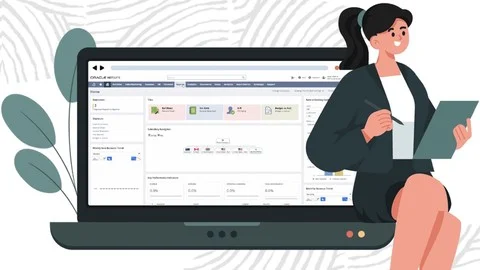
NetSuite ERP is a cloud platform that brings together core business functions like financials, inventory, and order management into a single, streamlined system. It is designed to scale and adapt to the unique needs of growing businesses across industries.
In this guide, we’ll break down its main features, benefits, and the key factors to consider before implementing NetSuite ERP.
NetSuite ERP supports a wide range of industries by offering flexible, industry-specific capabilities that help businesses streamline operations, improve efficiency, and scale with confidence. From eCommerce and manufacturing to services and healthcare, NetSuite adapts to the unique needs of each sector.
NetSuite enables online businesses to manage their storefront, inventory, orders, and customer interactions from one platform, with support for global operations including multiple currencies and tax rules.
Manufacturers can optimize production, manage inventory and supply chains, and support different production models such as make-to-order and assemble-to-order.
NetSuite provides real-time visibility into inventory, demand, and orders, helping distributors improve efficiency, reduce costs, and manage multiple warehouses and channels.
NetSuite provides real-time visibility into inventory, demand, and orders, helping distributors improve efficiency, reduce costs, and manage multiple warehouses and channels.
Retailers can deliver seamless omnichannel experiences by integrating POS, eCommerce, and marketplaces while managing inventory, pricing, and promotions in one system.
Nonprofit organizations can manage finances, donors, grants, and programs while benefiting from tools for reporting, fundraising, and compliance.
NetSuite supports subscription-based and SaaS models, helping companies manage billing, revenue recognition, and renewals efficiently.
Service firms can track projects, resources, time, and profitability while improving collaboration and overall project delivery.
Firms can meet regulatory requirements, manage multi-entity operations, and maintain strong financial controls across global activities.
Healthcare organizations gain better visibility and control over operations, including billing, supply chain, and performance analytics.
Educational institutions can manage students, finances, and programs while streamlining processes like enrollment, grading, and fundraising.
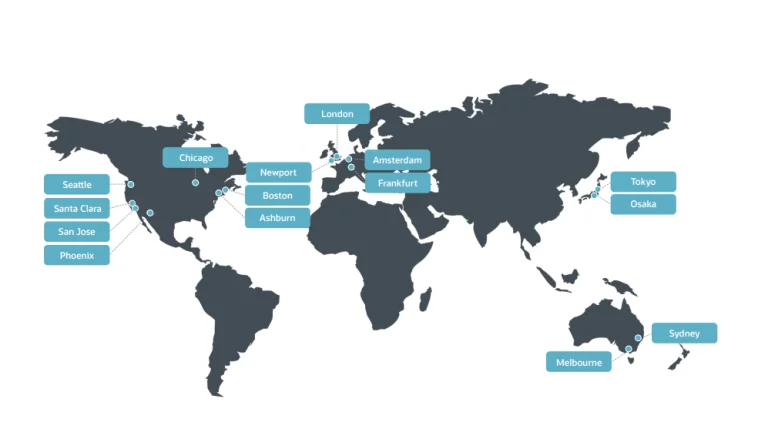
NetSuite operates a global infrastructure designed for high availability, security, and performance.
Global Data Cneter Presence
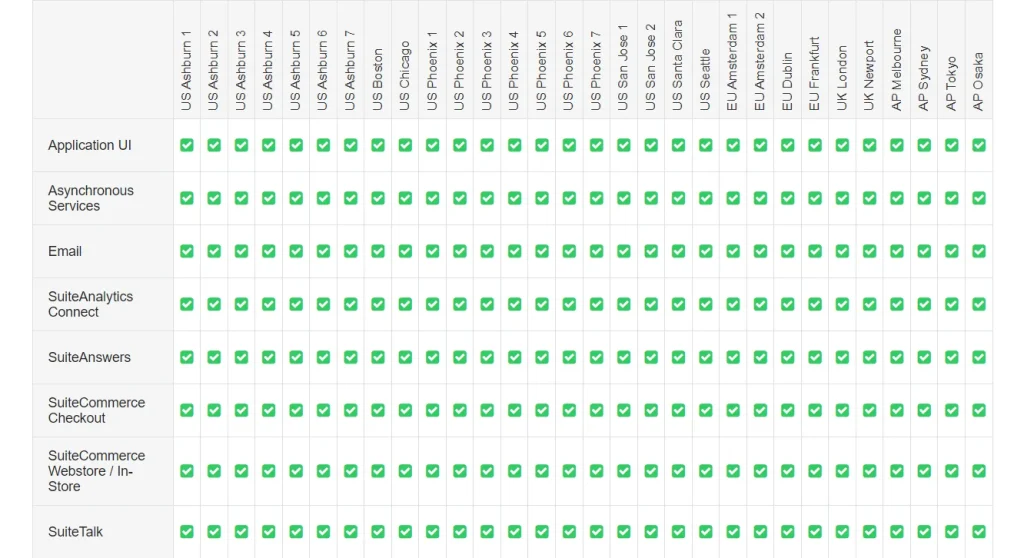
Reliability & Data Protection
Performance & Availability
The result is a secure, always-on system that keeps your operations running smoothly and your data protected. Stay informed with real-time updates on the NetSuite status page.
Looking beyond Oracle NetSuite ERP? Many businesses evaluate alternative cloud ERP solutions to compare capabilities, pricing, and implementation approaches before making a final decision.
When exploring ERP options, companies often assess key factors such as system flexibility, integration capabilities, implementation complexity, customer support, and industry-specific features. Product-centric businesses, in particular, look for solutions that align with their operational needs and long-term growth strategy.
Explore the full list of NetSuite competitors and compare top ERP solutions:
Several cloud ERP solutions offer strong alternatives to Oracle NetSuite, each with unique strengths depending on your business size, industry, and operational needs.
When exploring ERP options, companies often assess key factors such as system flexibility, integration capabilities, implementation complexity, customer support, and industry-specific features. Product-centric businesses, in particular, look for solutions that align with their operational needs and long-term growth strategy.
A flexible cloud ERP platform that covers financials, distribution, manufacturing, and project accounting. Known for its user-friendly interface, mobile access, and high level of customization.
An integrated ERP solution designed for small and mid-sized businesses, offering tools for accounting, sales, inventory, and analytics. It supports both cloud and on-premise deployment and is highly scalable.
A cloud-based financial management system tailored for growing businesses. It delivers strong accounting, reporting, and real-time insights, with seamless integration capabilities.
A comprehensive suite of ERP and CRM applications supporting finance, operations, sales, and customer engagement. It integrates smoothly with Microsoft tools like Office 365 and Power BI.
A modern cloud platform focused on financial management and human capital management. It is widely used by mid-to-large enterprises seeking advanced analytics and workforce management tools.
A modular and highly customizable ERP solution with both open-source and enterprise versions. It offers a wide range of applications including CRM, accounting, inventory, and manufacturing.
NetSuite ERP pricing depends on the size of your business, the number of users, the modules you need, your implementation scope, and any third-party integrations. In most cases, the total cost includes software licenses, support, implementation services, optional SuiteApps, and connectors.
To estimate the full investment, businesses typically calculate subscription costs, user access, implementation services, support requirements, and any add-ons needed to extend NetSuite’s functionality. Because every deployment is different, final pricing is usually tailored to each company’s requirements.
| NetSuite Licenses Pricing | |
| General Access User | $120 / month |
| Employee Self Service User | $19 / month (packs of 5) |
| Planning and Budgeting | $120 |
| NetSuite Support Pricing | |
| NetSuite Support | Included / varies by plan |
| Sandbox Environment | 10% of estimated price |
| NetSuite Implementation Pricing | |
| Small Implementation – 250 hours | $25,000 |
| Mid-Size Implementation – 400 hours | $40,000 |
| Enterprise Implementation – 600 hours | $60,000 |
| NetSuite Connectors by Celigo | |
| NetSuite Shopify Connector | $5,400 / year |
| NetSuite Salesforce Connector | $6,000 / year |
Total Solution Cost = (User License Cost × Number of Users) + Implementation Cost + Support Cost + Optional Add-Ons
NetSuite ERP pricing is not one-size-fits-all—the right investment depends on the scale, complexity, and growth goals of your business.
Netsuite Lisences: NetSuite follows a subscription-based pricing model, where costs depend on the number of users and selected modules. The subscription typically includes access to core ERP functionalities, with a base platform fee and additional per-user pricing.
SuiteApps: SuiteApps are third-party applications that extend NetSuite’s functionality across areas like CRM, eCommerce, inventory, and financial reporting. Pricing varies depending on the app, with some available for free and others requiring additional fees.
Support: NetSuite offers different support tiers. Essential support is usually included in the subscription, providing access to self-service resources and a knowledge base, while advanced support and managed services are available at an additional cost.
Implementation: Implementation includes system configuration, customization, data migration, and user training. Costs vary based on project complexity and business requirements, and are typically a one-time investment separate from the subscription.
Learn how Azkatech ensures successful NetSuite ERP implementations
Connectors & Integrations: NetSuite supports integrations with other platforms through connectors. Pricing depends on the integration scope and the systems involved, such as eCommerce or CRM platforms.
NetSuite works with a global network of partners to deliver implementation, customization, and extended solutions to businesses.
1. Alliance Partners
These partners focus on advisory and consulting services, helping businesses evaluate, implement, and optimize NetSuite based on their industry and operational needs.
2. Solution Providers
Solution providers are certified partners that sell, implement, and support NetSuite. They also deliver tailored solutions and ongoing services to ensure long-term success.
3. SuiteCloud Developer Network (SDN) Partners
These are independent software vendors (ISVs) that build applications and integrations to extend NetSuite’s functionality. Their solutions are available through the NetSuite ecosystem and marketplace.
Choosing the right NetSuite partner is key to ensuring a smooth implementation and maximizing long-term value from your ERP investment.
Yes, NetSuite can be tailored in multiple ways to match your business requirements and preferences. It provides a variety of customization tools, including:
1. SuiteBuilder
A visual, point-and-click tool that enhances the standard NetSuite setup by allowing you to create custom records, forms, fields, tabs, and other user-facing elements. It also enables you to adjust the user interface and printed documents to align with your branding and localization needs.
2. SuiteFlow
A workflow automation tool that helps streamline routine tasks and business processes through visually designed workflows—no coding required. You can define triggers, conditions, actions, and transitions to manage how data and processes move within NetSuite.
3. SuiteScript
A scripting framework that allows you to build custom applications and extend NetSuite functionality. Using JavaScript, you can create both client-side and server-side scripts, leveraging NetSuite APIs to interact with data and the user interface.
4.SuiteTalk
An integration tool that enables seamless data exchange between NetSuite and other systems, whether on-premises or cloud-based. It supports standard protocols like REST, SOAP, CSV, ODBC, and .NET, and allows access to NetSuite APIs and webhooks to trigger actions based on system events.
NetSuite supports payroll processing for U.S.-based employees through its SuitePeople Payroll solution. This end-to-end system automates key payroll functions, including:
NetSuite Payroll helps streamline payroll operations, minimize errors, ensure compliance, reduce administrative costs, and improve visibility into payroll expenses. Additionally, several SuiteApp payroll solutions are available to extend NetSuite’s payroll capabilities.
5 Payroll Solutions for NetSuite (SuiteApps)
1. SuitePeople US Payroll
SuitePeople US Payroll is an all-in-one payroll solution built for companies operating in the United States. It automates key payroll activities, including calculations, tax withholdings, and deductions, helping ensure accurate, timely processing while maintaining compliance with federal and state regulations.
2. Inopeople Middle East Payroll
Inopeople Middle East Payroll is designed for organizations across the Middle East, supporting country-specific payroll requirements and regulations. It enables efficient payroll management, including compliance with local labor laws, tax calculations, and region-specific employee benefits.
3. Deputy (SuiteApp from Australia)
Deputy is a workforce management platform that simplifies employee scheduling, time tracking, and team communication. Its integration with NetSuite allows seamless transfer of timesheets, making it easier to manage payroll and workforce operations, including onboarding, shift scheduling, and clock-in/clock-out tracking.
4. UKG PayrollPro (SuiteApp from Canada)
UKG Pro delivers a unified cloud solution for HR, payroll, and talent management, supported by advanced analytics. When integrated with NetSuite, it enables organizations to manage their full business lifecycle—from financials and supply chain to HR and payroll—within a scalable and flexible cloud environment.
5. Infinet Cloud (SuiteApp from UK)
Infinet Cloud Payroll supports payroll processing across regions such as Australia, New Zealand, and the UK. It ensures compliance, manages updates, and handles leave tracking. Used by hundreds of NetSuite customers globally, it simplifies payroll management across multiple jurisdictions with easy access to payroll data.
Yes, NetSuite can be integrated with a wide range of systems through the SuiteCloud Platform. This integration framework allows secure data exchange between NetSuite and both on-premises and cloud-based applications using standards such as REST, SOAP, CSV, ODBC, and .NET.
Additionally, the NetSuite Connector enables easy data mapping between NetSuite and platforms like eCommerce stores, POS systems, online marketplaces, and third-party logistics providers. These integrations help unify systems, automate workflows, and improve overall business visibility.
1. Explore NetSuite Learning Resources
NetSuite provides a wide range of learning materials, including documentation, tutorials, videos, and webinars. You can start with the NetSuite Help Center and SuiteAnswers knowledge base, where you’ll find detailed guides covering various features and functionalities.
2. Take NetSuite Training Programs
Through the SuiteTraining program, NetSuite offers structured learning options such as instructor-led courses, virtual sessions, and self-paced modules. These programs are tailored to different roles and skill levels, helping you focus on the areas most relevant to your needs.
3. Pursue Professional Certification
NetSuite certifications allow professionals to validate their skills across different roles, including administrators, developers, consultants, and finance users. Earning a certification can strengthen your credibility and demonstrate your proficiency in using NetSuite.
4. Practice with a Sandbox Environment
NetSuite’s sandbox environment enables you to test configurations, explore features, and gain hands-on experience without impacting live data—making it ideal for safe experimentation and learning.
1. Administrator Certifications
This category includes SuiteFoundation (a prerequisite for all certifications) and the NetSuite Certified Administrator credential. These certifications focus on managing and maintaining a NetSuite environment and are suitable for power users, administrators, developers, and consultants seeking a broad understanding of the system.
2. User Certifications
This group includes product-specific certifications that assess your ability to work with key NetSuite modules and features. They are particularly relevant for finance and accounting professionals working with areas like ERP, SuiteAnalytics, SuiteCommerce, Financials, and Advanced Revenue Management. These certifications are more focused and role-specific.
NetSuite ERP is a flexible, cloud-based platform designed to support core business operations such as accounting, inventory, and order management. It offers key advantages including scalability, real-time visibility, automation, and integration across systems.
At the same time, adopting NetSuite requires careful planning due to factors such as system complexity, cost, and the learning curve involved. Businesses should evaluate their needs and objectives to determine if it’s the right fit.
If you’d like to learn more about NetSuite or explore how it can support your business, feel free to reach out to Azkatech for more information or request a demo.
Azkatech is an Odoo Gold Partner in Lebanon and an emerging NetSuite ERP implementer, helping businesses streamline operations and support growth.
The Power of NetSuite Modules for Modern Businesses Discover how...
Read More50 Top Oracle NetSuite Demo Videos Explore our curated selection...
Read MoreTalk to our Experts to find out how our consulting and technology can transform your business.