
Every company in Lebanon has to keep books, file VAT and tax on time and report in both Lebanese pounds and dollars. This guide to Lebanese accounting explains what that work includes, how outsourced accounting compares with an in-house team, and which tasks a good accounting system can take off your hands.

With outsourced accounting, an external firm runs your day-to-day bookkeeping and filings while you run the business. Done well, it feels like having your own accounting department:
The catch is that the firm only sees what you give it. If your invoices, stock and payroll live in different tools, your accountant spends their hours collecting data instead of checking it.
Whoever does the work, in-house or outsourced, these are the obligations that come with a company in Lebanon:
| Obligation | What it means |
|---|---|
| Chart of accounts | Most commercial companies use the unified Lebanese chart of accounts (Law 27 of 1980), with financial statements under IFRS |
| VAT | 11% standard rate. Registration is required above LBP 5 billion of taxable turnover, and the return and payment are due within one month after each quarter |
| Corporate income tax | 17% on profits. Capital companies file by 31 May of the following year |
| Payroll tax | Salary tax withheld monthly and filed quarterly on form R10 |
| Statutory audit | An independent auditor registered with LACPA reviews the accounts of companies that need one |
| Record keeping | Books and supporting documents kept for ten years |
| Currency | Reporting in LBP, even when most invoices and salaries are in US dollars |
Late filings are costly: late VAT returns are charged 5% of the tax per month, up to the full amount due, plus 3% per month on late payment.
Outsourced accounting is usually sold in two levels. A basic plan covers reconciliations and tax. A complete plan adds full bookkeeping. The table shows what each one includes, and which tasks an accounting system like Odoo can do on its own:
| Task | Basic | Complete | Automated in Odoo |
|---|---|---|---|
| Account reconciliation | |||
| Reconcile bank accounts | Yes | Yes | Bank feeds matched to invoices and bills |
| Bring electronic transactions into the accounting system | Yes | Yes | Imported and matched automatically |
| Reconcile credit card accounts | Yes | Yes | Card statements matched to expenses |
| Tax | |||
| Tax preparation (VAT, corporate tax, R10) | Yes | Yes | VAT calculated from every invoice, ready for the quarterly return |
| Bookkeeping | |||
| Track credit card expenses and receipts | No | Yes | Receipts scanned and posted from the phone |
| Process employee expense reports | No | Yes | Submitted, approved and reimbursed in one flow |
| Record payments to freelancers and contractors | No | Yes | Vendor bills with the right withholding |
| Digital access to paid bills | No | Yes | Every bill and payment stored with its document |
| Quarterly review of key figures | No | Yes | Live dashboards, any day of the quarter |
Basic suits small companies that keep their own records and only need help closing the month and filing. Complete suits companies that want someone else to handle the books entirely.
Both set-ups work. The right one depends on your size, how much control you want and how complex your operations are:
| Outsourced accounting | In-house accountant or team | |
|---|---|---|
| Cost | Fixed monthly fee, no salaries or NSSF | Salaries, NSSF and training |
| Tax knowledge | A firm that files for many companies | Depends on the person you hire |
| Speed of answers | Depends on the firm’s response time | Same day, in the office |
| Control over data | Shared access, firm does the entries | Full control, done by your staff |
| Best for | Small and growing companies | Companies with many transactions or branches |
Many Lebanese companies mix the two: an in-house accountant for daily entries and an outside firm for tax filing and the yearly audit.
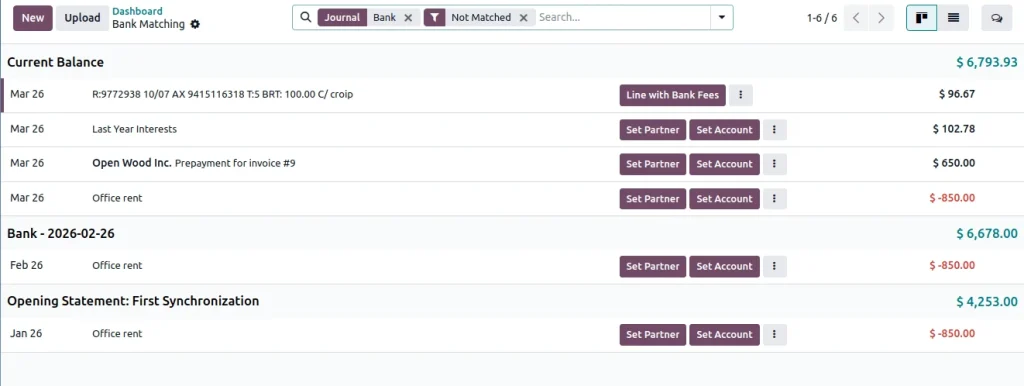
Whether your accountant sits in your office or in a firm across town, they work from the same place: your accounting system. When sales, purchases, stock and payroll all post to one system, the month closes faster and the accountant’s hours go to checking numbers, not typing them.
A system set up for Lebanon should already include the Lebanese chart of accounts, LBP and USD reporting, VAT on every invoice and the reports the Ministry of Finance asks for.
Azkatech is an official Odoo Gold Partner based in Beirut. We don’t do bookkeeping or tax filing ourselves. We set up Odoo Accounting so your in-house team or your outside accountant works in a system that already follows Lebanese rules:
Most commercial companies keep books on the unified Lebanese chart of accounts under Law 27 of 1980 and prepare financial statements under IFRS, which Lebanon adopted in 1996.
The standard VAT rate is 11%. Companies above LBP 5 billion of taxable turnover must register, and the return and payment are due within one month after each quarter.
Capital companies file by 31 May of the year after the income year, and other entities by 31 March. Payment is due on the same date.
Yes. Many Lebanese companies outsource bookkeeping and tax filing to an accounting firm, while the company stays responsible for its books and filings.
Accounting books and supporting documents must be kept for ten years.
Many companies invoice and pay in dollars, but tax reporting is in Lebanese pounds at the official exchange rates, so the books need to report in both currencies.
Rates and deadlines in this guide were checked on 17 November 2026. They change often in Lebanon, so confirm with the Ministry of Finance or your accountant before you rely on them.
Tell us how your accounting runs today. We’ll show you how Odoo fits your team and your accountant.